The Problem With Paper KOTs
Every restaurant has a version of this story: a KOT slip falls behind the counter, a table waits 45 minutes, the manager has no idea where the order is, and the customer leaves a 2-star review.
Paper KOTs — Kitchen Order Tickets — are unreliable, untrackable, and completely analog in an age where your business generates digital data at every other touchpoint.
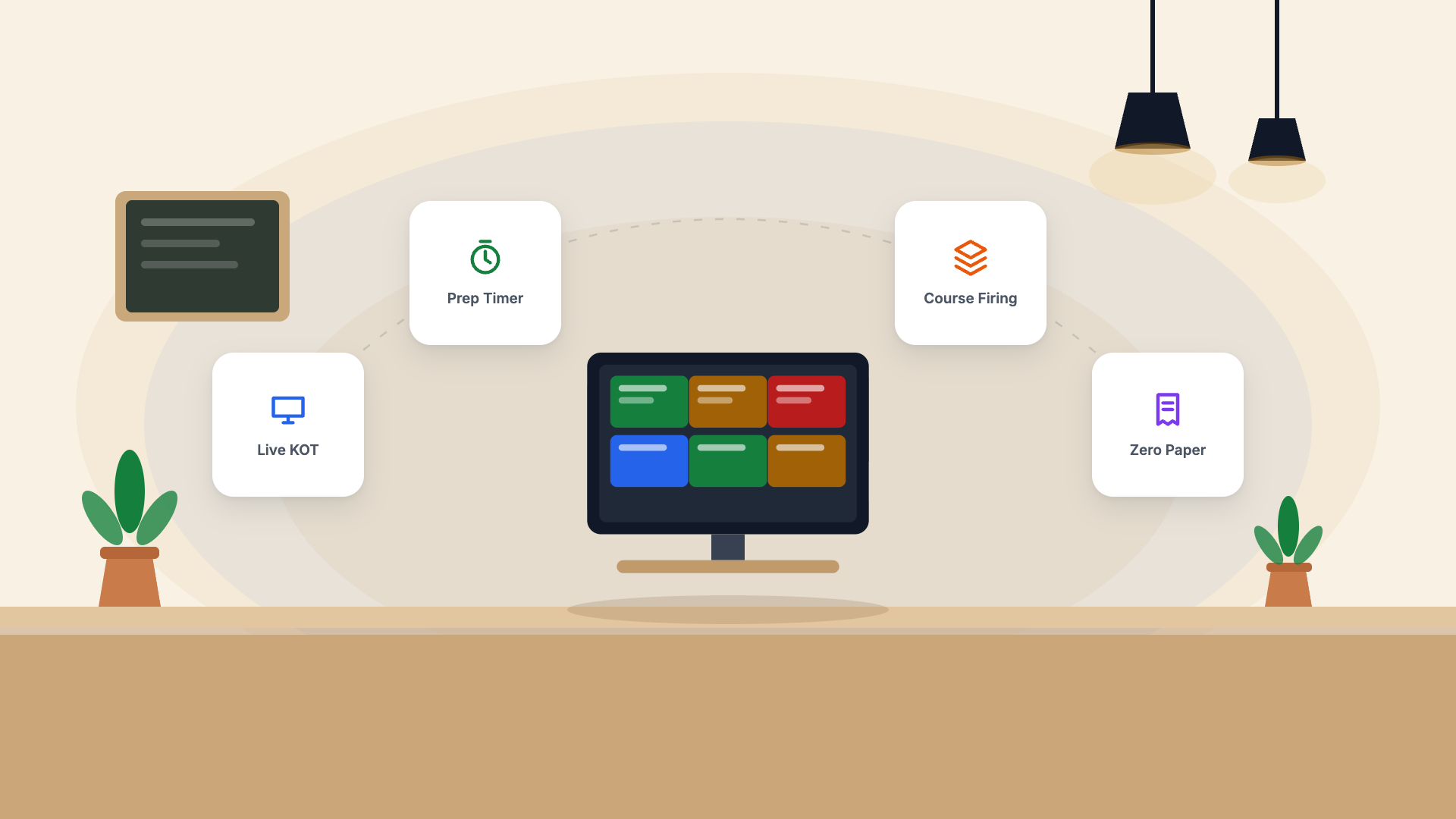
A Kitchen Display System (KDS) replaces paper KOTs with a screen mounted in the kitchen that displays orders in real time, shows preparation timers, and updates automatically when items are ready.
How a KDS Works
1. Customer places an order — at the table via your POS, or online via Zomato/Swiggy
2. Order appears on the KDS screen instantly — broken down by station (grill, cold kitchen, bar, etc.)
3. Chef sees the order and starts preparation
4. Timer starts — you can see at a glance how long each order has been waiting
5. Chef marks items done — the POS updates, the server is notified, and the order moves to a "ready" state
6. Manager sees order flow — which orders are on time, which are delayed, and where the bottleneck is
KDS vs Paper KOT: Side-by-Side
| Feature | Paper KOT | KDS |
|---|---|---|
| Order visibility | Only the chef holding the slip | Entire kitchen + manager |
| Lost orders | Common | Impossible |
| Modification handling | Reprint and hope | Instant update with alert |
| Timing data | None | Full per-order analytics |
| Noise | Printer noise per order | Silent |
| Multi-station routing | Manual | Automatic by station |
Does Your Restaurant Need One?
You definitely need a KDS if:
- You're doing more than 50 covers per service
- You have more than one kitchen station
- You experience frequent order errors or mix-ups
- You take online orders alongside dine-in
A KDS might be overkill if:
- You're a single-station micro kitchen with under 20 covers
- You primarily do takeaway only with simple menu items
KDS in Pangat
Pangat's built-in KDS routes orders to the correct kitchen station automatically based on the item category. A pizza goes to the oven station, a salad to the cold kitchen, a cocktail to the bar — simultaneously and instantly. Each station sees only what's relevant to them.
Average order completion time drops by 18–22% in the first month based on our restaurant data.